
- Abolition of tax on imputed rental value 2025
- Security instructions
- Switzerland is on the move
- How far your budget can stretch in different parts of Switzerland
- Rebranding
- Mortgage interest rates: how borrowers can save thousands of Swiss francs
- More apartments on the market
- Promising places for apartment hunters

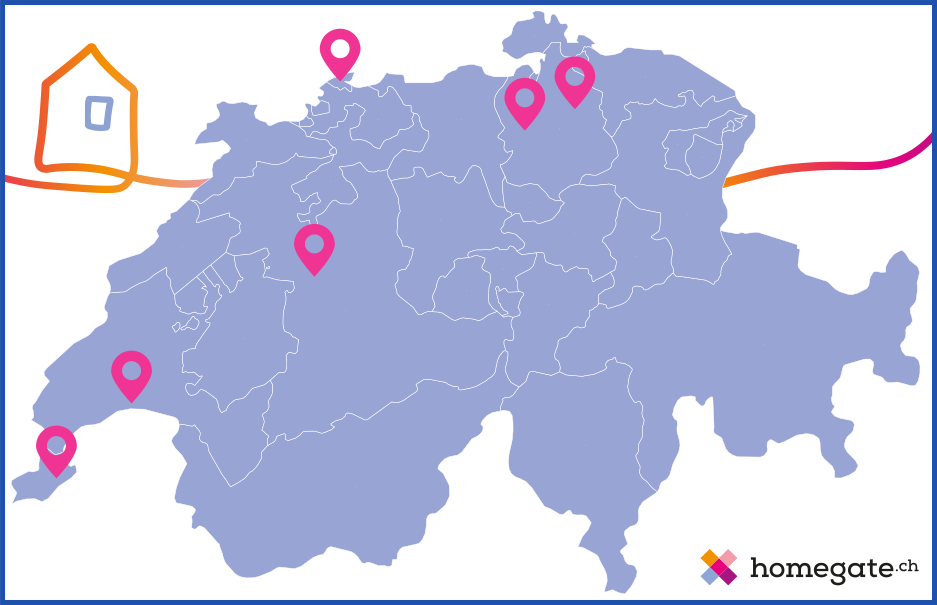
Six promising places for people looking for an apartment
Rents in Switzerland are rising steadily, while the vacancy rate fell again last year. Many people are experiencing difficulty finding an apartment. However, new opportunities are opening up in and around some cities: urban development projects and conversions will provide additional living space in the coming years. We present the vacancy rate situation in Switzerland and show places and projects that are looking particularly exciting for tenants.
Vacancy rate at its lowest
According to the Federal Statistical Office (FSO), the vacancy rate has continued to fall this year, continuing a trend that has already been going on for four years. The figure is currently only 1% across Switzerland.
According to architect and real estate manager Jack Marcolin (Bucher Guyer AG), the low vacancy rate can be explained by a combination of several factors: “The demand for apartments, mainly caused by the immigration of skilled workers (expats), far exceeds the current supply.
The development and construction of new buildings in Switzerland’s major cities and their conurbations is also under enormous strain due to tightening of building laws, delays in planning applications, additional regulatory bodies, objections by residents, etc., which in turn exacerbates the shortage of affordable rental apartments in these economic centres.
In regions with high potential (whether urban or rural), which can be reached by target groups in 30 to 60 minutes by public transport, the authorities should be able to use simplified and, above all, faster procedures to develop future construction projects.”
More and more construction projects are being launched, but this still cannot meet the extremely high demand for rental apartments. In Switzerland, there is an annual additional requirement of at least 50,000 apartments, due in particular to immigration in recent years of around 70,000 to 80,000 people.
The high demand for apartments and the slow progress of construction projects mean that more and more tenants are moving to the outskirts of larger cities. Continuously rising rents and the demolition of older apartment blocks in favour of new construction projects are also driving more and more city dwellers to move more or less voluntarily to surrounding areas.
Urban areas with particularly strong rental pressure
The housing shortage is particularly acute in urban centres such as the Greater Zurich Area and the Lake Geneva region. Prices in these regions are expected to continue to rise in the future. So it’s a good time to examine your own options and plan for the coming years with foresight.
We’ve selected a few places with exciting (upcoming) residential construction projects to show you:

Winterthur railway station and Stellwerk 2
Winterthur is one of the most liveable cities in Switzerland, thanks in part to its numerous educational, service, cultural and leisure facilities. New neighbourhood developments and residential construction projects make Winterthur and the surrounding area an attractive growth location for rental apartments, especially for commuters who appreciate its proximity to Zurich.
If you’d like to live in the heart of Winterthur, you’ll be able to get your money’s worth around Winterthur railway station in the near future. Several promising projects are being planned there, including the Stellwerk 2 project right next to the current Stellwerk 1. The project comprises a modern building that will include offices and retail space as well as living space.
- The location is particularly suitable for prospective tenants looking for a good connection to the Greater Zurich Area. The tenant fit-out is expected to begin in the fourth quarter of 2027, with completion of the project scheduled for the second quarter of 2028.
- Information about the project can be found on the official Stellwerk 2 website.
City of Basel and Dreispitz Nord
The number of residential units approved or already under construction in Basel continues to rise. In 2024 alone, 442 residential units were granted building permits in the city. This figure has not been reached since 2020.
At the start of 2025, 934 apartments were still under construction, with a further 574 apartments already approved. This means that around 1,500 apartments will be ready for completion in the coming years. By comparison, at the end of 2023, there were fewer than 1,000 apartments. A slight upward trend can therefore be observed in Basel.
Lukas Ott, Head of Cantonal and Urban Development in the city’s Presidential Department, is also getting prospective tenants in Basel interested: “In recent years, the Grand Council has approved several development plans for larger residential projects, for which planning applications are expected to be submitted gradually. We therefore expect another high level of residential construction activity to be reached from the end of the 2020s. From 2035, planning for the largest transformation sites in the canton – klybeckplus and Dreispitz Nord, as well as port and urban development – will make the greatest contribution to the creation of living space.”
Dreispitz Nord
A new urban neighbourhood with around 800 apartments is to be built on the Dreispitz Nord site. Plans include affordable and non-profit housing. In addition to apartments (1- to 4-bedroom apartments), a school, office and commercial spaces, cafés and restaurants, small shops, green and open spaces and a youth club are planned.
The district will be easily accessible by public transport and just three stops from Basel railway station. In addition, new cycle and footpath connections and 4,000 bicycle parking spaces will create excellent conditions for a “low-traffic environment” in Dreispitz Nord.
Construction planning will begin after legally binding final approval. Construction is expected to start in 2028. The project is currently still in the planning and approval phase. Interested parties will have to wait a little longer.
- The location is particularly suitable for young families, environmentally conscious professionals and people who want to experience urban and green living in the same place. Dreispitz Nord is also suitable for anyone looking for modern and diverse living space in Basel.
- Information about the project can be found on the official Dreispitz Nord website.
Geneva: Praille‑Acacias‑Vernets
The Praille-Acacias-Vernets (PAV) urban development project covers areas in the municipalities of Geneva, Carouge and Lancy and is one of the most ambitious urban development projects in Europe. It represents the greatest housing potential for Geneva. Nine new districts with thousands of apartments are to be built on former industrial sites.
In total, 140 hectares of former industrial land in the 230-hectare area will be converted into residential and usable space. The mixed-use concept south of Geneva promises not only a significant addition to housing in a central location, but also local recreation facilities in the form of green spaces.
- The location is particularly suitable for tenants who want to enjoy a mixed urban district that is designed to be almost entirely pedestrian-friendly and offers space for both housing and a variety of outdoor activities.
According to the official website of the canton of Geneva, 2,230 apartments are planned in the Les Acacias district of PAV alone, which will accommodate around 5,500 people from 2030. In addition, around 1,500 new jobs will be created on top of the 700 existing ones.
Overall, however, significantly more apartments and jobs are to be created on the 140 hectares. With 12,000 planned apartments, 6,000 new jobs and extensive green spaces and public facilities, PAV is likely to become a sought-after place to live.
- Information about the project can be found on the official PAV website.
Zurich and Ecublens (VD): student accommodation in the Student Village and Les Triaudes
Unaffordable housing or the neverending daily commute: all too often, students’ lives are made unnecessarily difficult. However, an increasing number of universities are meeting students’ needs: in many cases, university growth no longer only leads to demand, but also to expansion measures in student and general housing.
Examples include the École Polytechnique Féderale de Lausanne (ÉPFL) and the three interlocking buildings of the Student Village on ETH’s Hönggerberg campus. They all offer accommodation that is tailored to the needs and wishes of students.
Student Village
ETH’s Student Village has apartments with six to ten bedrooms for flat shares, as well as studios for students who prefer to live alone. Further information can be found on the official Student Village website.
Les Triaudes
In Ecublens (VD), close to the ÉPFL, students and research staff at the university have the opportunity to live in one of 194 furnished apartments in the Les Triaudes residential complex. All apartments have two to five bedrooms and are a few minutes’ walk from the campus. More information can be found on the official Les Triaudes website.
Neighbourhoods around Bern railway station
Bern station is the second-largest railway station in Switzerland. Nevertheless, in recent years it has come up against its spatial and operational limits. The Zukunft Bahnhof Bern (Future Bern Station) project was therefore conceived to rebuild, expand and modernise the station area.
The comprehensive redesign of the station and its surroundings is intended to create building land and facilitate numerous new-build and extension projects right next to a public transport hub, thus creating ideal conditions for commuters and apartments close to the city. New underpasses, entrances and public spaces are to be built for the station.
It’s important to note that the expansion of the station increases the demand for central living, but does not in itself create any new housing. The future of adjacent neighbourhoods looks more promising, as shorter routes around the area, better connections and better urban quality will significantly increase their attractiveness as residential areas.
Neighbourhoods such as Länggasse and Breitenrain benefit indirectly from the station expansion. The new underpasses improve accessibility and make the neighbourhoods more attractive. Against this backdrop, it is more likely that existing buildings will be more densely occupied, be converted or undergo change of use to meet the growing demand for central living space. It is therefore worth keeping an eye on the development of these neighbourhoods.
Information about the project can be found on the official Zukunft Bahnhof Bern website.


